StayNia
Find trusted stays across Kenya.
A responsive accommodation marketplace prototype for discovering fixture-based stays across Kenya.
Next.js / React / TypeScript / Playwright

Overview
A responsive accommodation marketplace prototype for discovering fixture-based stays across Kenya.
Problem
Accommodation marketplace interfaces need property discovery, filtering, pricing information, and detail pages while remaining usable across different devices.
What Afrinex Delivered
Built a Next.js marketplace prototype with destination search, URL-backed filters, sorting, reusable property data, statically generated detail pages, internal API routes, responsive property cards, SEO metadata, and browser testing.
Architecture
01 / Frontend
Marketplace UI
Responsive discovery and property views
02 / Backend / API
Internal API routes
Property collection and detail endpoints
03 / Database
Canonical fixtures
Shared property data for UI and API responses
04 / Infrastructure
Static property pages
Generated detail routes
Implemented Features
- Destination search, filtering, sorting, result counts, and clear filters
- URL-backed discovery state
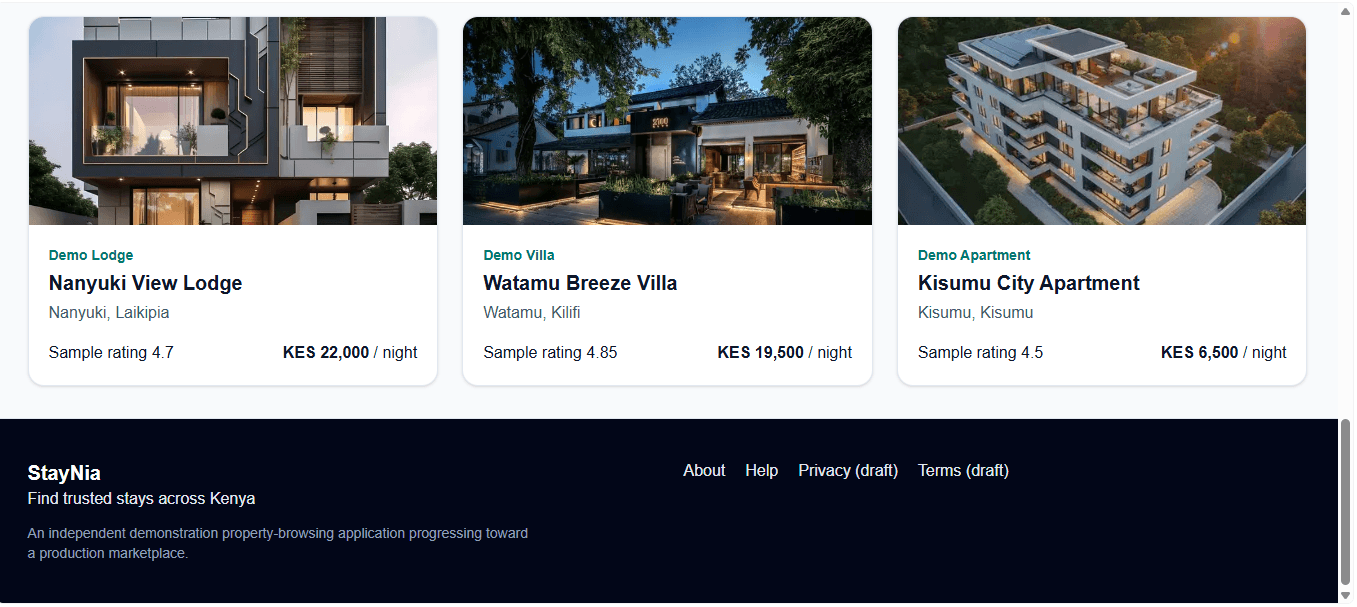
- Reusable property cards backed by canonical fixture data
- Statically generated property-detail pages and image galleries
- Guest capacity, amenities, sample ratings, KES pricing, and related stays
- Internal property collection and detail API routes
- Responsive layouts, custom 404 handling, and demo disclosures
Testing
Playwright browser tests cover desktop and mobile user paths, with unit validation included where supported by the project.
SEO
The prototype includes page metadata, dynamic robots output, a restricted sitemap, statically generated property routes, and a custom not-found experience.
Current Limitations
StayNia currently uses fixture/demo data. Authentication, a production database, reservations, real availability, payment processing, live inventory, host onboarding, and submitted contact forms are intentionally not implemented.
Engineering Insights
The build reinforced four practices that carry into comparable Afrinex work: keeping UI and API responses aligned through a single shared data source, representing discovery state in the URL so results stay shareable, testing responsive journeys across desktop and mobile, and drawing a clear line between a working prototype and future transactional features.
Screenshots
Have a similar project in mind?
This case study documents founder-built work demonstrating the engineering capability behind Afrinex. If you need comparable software, data, automation, or website work, describe your requirement and Afrinex will confirm whether it can help.